CNC Machined Parts for Aerospace & Defense
Aerospace sourcing usually fails on documentation, not on cutting. Here, tight-tolerance components from certified aerospace alloys ship with full material traceability, FAI reports, and AS9100-aligned documentation — every order.
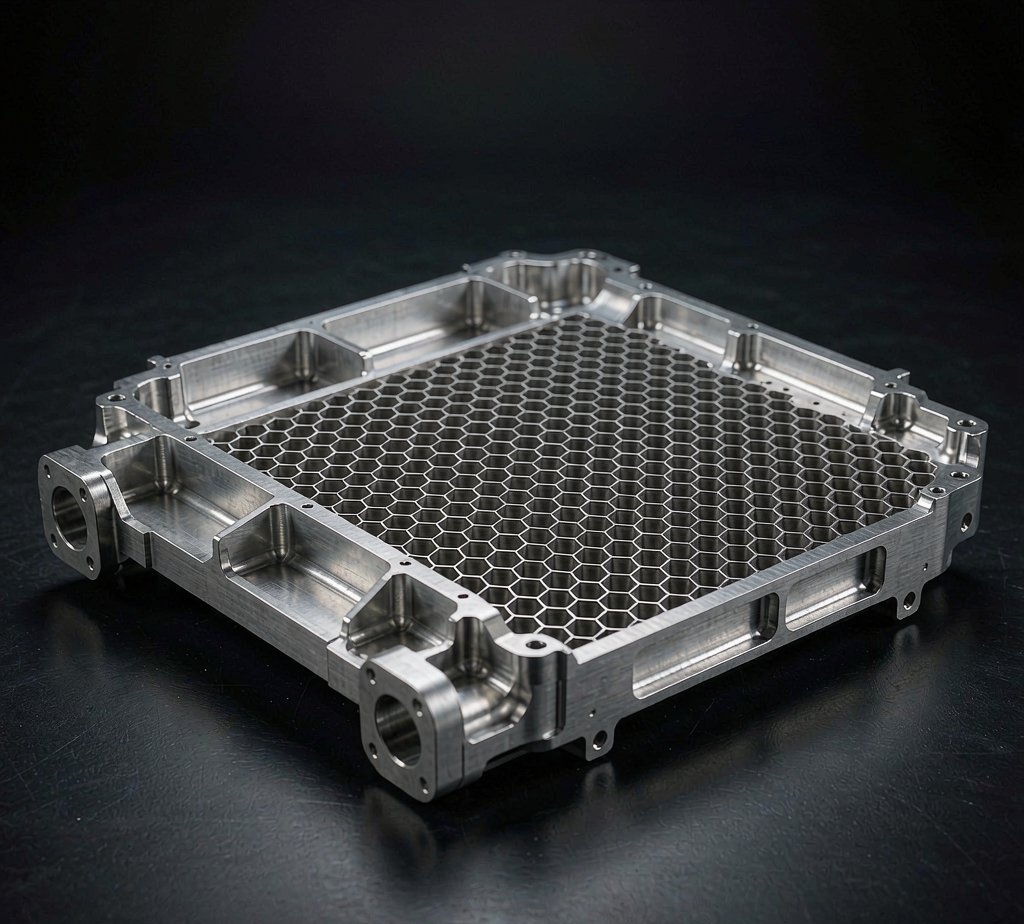
Titanium work: we run Ti-6Al-4V regularly. See our titanium machining guide for parameters and the fire safety requirements.
Aerospace Programs We Support
If you run UAV, satellite, aircraft-interior or ground-support programs, these are the components we machine weekly — each one with full mill certification, first-article inspection, and process documentation aligned to AS9100 expectations.
Why Aerospace Programs Choose CNC Over Casting or Forming
For low-to-mid volumes and geometrically demanding parts, 5-axis CNC milling and multi-axis turning give aerospace programs a faster, lower-risk path than casting or forming. There is no tooling lead time and no minimum order quantity, and every feature is machined from a solid billet so grain flow and wall thickness stay under the engineer's control. This matters most for UAV airframes, satellite deployment mechanisms, and prototype flight hardware, where a design may change several times before certification and a hard tool would be obsolete on revision two.
Machining Challenges with Aerospace Alloys
The alloys that make aerospace parts light and strong are also the hardest to cut, and the setup has to respect that. Titanium Ti-6Al-4V work-hardens under the tool if the feed is too low and ignites if coolant is lost, so we run rigid fixturing, sharp PVD-coated or uncoated carbide, and flood coolant at conservative speeds. Aluminum 7075 and 2024 are gummy at the surface and tear if the rake angle is wrong; 2024 also builds a heavy built-up edge that needs frequent tool changes. Stainless 17-4PH strain-hardens and generates heat that wants to weld to the flute. Thin-wall brackets and pockets need support fixtures and step-down roughing so the part does not chatter or spring away from the cutter — we compensate with in-process probing on critical features rather than relying on the final inspection to catch movement.
Material Traceability & Documentation Flow
Every aerospace order ships with an EN 10204 3.1 material certificate tied to the heat number, plus a first-article inspection report per AS9102 for new or revised part numbers. Dimensional data is captured on a CMM and cross-checked against the drawing ballooning. Where a part involves special processes — anodize, passivation, or NDT — we collect the sub-supplier certificates into one package so your quality team receives a single source of truth. Configuration control is strict: any drawing revision triggers a new FAI, never a reused report.
Lightweighting: Design Notes for Buyers
Two changes cut weight and cost on most aerospace brackets. First, consolidate multi-part assemblies into a single 5-axis machined component so fasteners and overlap margins disappear. Second, replace solid webs with ribbed or pocketed geometry that keeps stiffness only where the load path runs. Where a part must survive vibration and thermal cycling, favor 7075-T7351 over 6061 for the higher fatigue strength, but expect a longer lead on stress-relieved stock. Send us the load path and we will propose wall thicknesses and fillet radii that machine cleanly without sacrificing the margin you calculated.
Typical Parts We Make for Aerospace Customers
- UAV airframe components and motor mounts
- Satellite bracketry and deployment mechanisms
- Aircraft interior fittings and panel components
- Ground-support equipment (GSE) tooling and fixtures
- Drone propulsion components and cooling plates
- Lightweight aluminum and titanium structural brackets
Common Materials and Grades
- Aluminum 7075-T7351 — aerospace structural
- Aluminum 2024-T3 — fatigue-critical airframe
- Titanium Ti-6Al-4V — high-strength, low-weight
- Stainless 17-4PH H1025 — landing gear and high-load components
- PEEK — thermal and electrical insulation
Tolerances and Finish Capabilities
| Specification | Capability | Notes |
|---|---|---|
| Standard tolerance | ±0.025 mm | Tighter than general industrial |
| Precision tolerance | ±0.01 mm | For critical features and mating parts |
| Surface roughness | Ra 0.8 µm | Per aerospace spec |
| Material certs | EN 10204 3.1 included | Full traceability |
Frequently Asked Questions
Do you have AS9100 certification?
Can you provide first-article inspection (FAI) reports?
How do you handle ITAR and export-controlled designs?
What is your typical lead time and minimum order quantity?
What tolerance can you hold on thin-wall titanium and aluminium brackets?
Do you machine Inconel and other nickel alloys for turbine and engine parts?
Do you machine CNC parts for aerospace?
Which materials do you use for aerospace CNC?
Can you hold tight tolerances for aerospace parts?
Do you provide documentation and inspection for aerospace orders?
Ready to start your project?
Send drawings — get a detailed quote within 24 hours.
Industry cross-link: CNC Machining for Automotive
Related: CNC machining in China — sourcing from a vetted Shenzhen supplier
Knowledge base: Browse the CNC Machining Knowledge Base