Aluminum Grade Selection Chart for CNC Machining
A working shop's reference for picking the right aluminum — 6061, 7075, 5052, 2024, 6063, 2A12 — with real numbers, anodizing response, weldability, and a decision tree. Bookmark this page; we update it when suppliers ship new stock.
Why This Chart Exists
Choosing between aluminium, stainless and titanium? Start with our three-material comparison — this page is for picking the alloy once you've settled on aluminium. For the machining side — tolerances and anodizing on aluminum parts — see our aluminum CNC machining guide.
Every week a buyer emails us a drawing and asks "should this be 6061 or 7075?" Sometimes the answer is obvious. More often it isn't — and picking the wrong grade wastes a week of machining time, or worse, ships a part that fails in service.
This chart is the shortlist of aluminum grades that actually come across our desks on CNC jobs. The mechanical properties are typical room-temperature values compiled from published reference sources — the ASM Metals Handbook (Vol. 2), MatWeb material data sheets, the Aluminum Association datasheets, and ASTM B209 (sheet/plate) / B221 (extrusions) specifications. Every number in the table traces to one of those public sources, listed in the sources & notes section below. Where a property is load-bearing in your design, always work from the mill test report for the lot you actually receive — typical values vary with product form and section size.
If you're not sure which column to use: jump to the decision tree at the bottom. If you're spec'ing a part that has to survive a stress simulation, also read the strength vs machinability section — that tradeoff decides 80% of parts.
All Six Grades at a Glance
Scroll right on mobile. Properties shown for the most common temper — T6 for heat-treated grades, H32/H34 for work-hardened. For other tempers see the footnotes.
| Property | 6061-T6 | 7075-T6 | 5052-H32 | 2024-T3 | 6063-T5 | 2A12-T4 |
|---|---|---|---|---|---|---|
| Yield strength (MPa) | 275 | 503 | 193 | 345 | 145 | 325 |
| Tensile strength (MPa) | 310 | 572 | 228 | 483 | 185 | 470 |
| Fatigue strength (MPa, 10⁷ cycles) | 96 | 159 | 117 | 138 | 69 | 138 |
| Elongation at break (%) | 12 | 11 | 12 | 18 | 12 | 19 |
| Density (g/cm³) | 2.70 | 2.81 | 2.68 | 2.78 | 2.70 | 2.78 |
| Melting range (°C) | 582–652 | 477–635 | 607–650 | 502–638 | 615–655 | 502–638 |
| Machinability rating (vs 2011=100%) | 90% | 80% | 50% | 70% | 60% | 75% |
| Weldability (TIG/MIG) | Excellent | Not recommended | Excellent | Poor | Excellent | Poor |
| Anodizing response | Excellent (color & hardcoat) | Acceptable (streaks possible) | Good (hardcoat only) | Limited (special process) | Excellent (decorative) | Limited |
| Corrosion resistance (atmospheric) | Good | Fair (prone to SCC) | Excellent (marine grade) | Poor | Good | Poor |
| Formability (cold) | Good | Poor | Excellent | Fair | Excellent | Fair |
| Relative cost (per kg, China mill, 2026) | 1.0× baseline | 1.4× | 1.05× | 1.3× | 1.0× | 1.1× |
| Typical applications | Frames, brackets, housings, general | Aerospace structural, high-stress parts | Sheet metal, marine, fuel tanks | Aircraft skins, truck wheels, screws | Extrusions, heat sinks, architectural | Aerospace skins, military (CN-spec) |
SCC = stress corrosion cracking. Costs are indicative; confirm with current mill quote. SCC resistance of 7075-T6 is markedly improved in the T73 temper (overaged, ~10% lower strength).
Sources & Notes
Every number in the table above is a typical room-temperature value compiled from published reference sources, not an original measurement. Use the mill test report for the lot you actually receive when a property is load-bearing. Primary references:
- ASM Handbook, Volume 2 — Properties and Selection: Nonferrous Alloys and Special-Purpose Materials. Yield, tensile and fatigue strength for 6061-T6 and 7075-T6.
- MatWeb Material Property Data — density, thermal and mechanical properties per UNS designation (A96061, A97075, A95052, A92024, A96063).
- The Aluminum Association — Aluminum Standards and Data, registered alloy compositions and temper designations.
- ASTM B209 (Aluminum and Aluminum-Alloy Sheet and Plate) and ASTM B221 (Aluminum and Aluminum-Alloy Extruded Bars, Rods, Wire, Profiles, and Tubes) — specification limits by product form.
Machinability ratings follow the standard relative scale (2011-T3 free-machining alloy = 100%). Weldability, anodizing response and corrosion-resistance labels are qualitative, consolidated from the same references. The 2A12-T4 values are the Chinese GB/T designation chemically and mechanically equivalent to 2024-T3 (within ~5%); where your drawing calls out 2A12, treat 2024-T3 published data as interchangeable.
Last updated: 2026-10-03.
The Decision Tree
The one question that decides most parts
Ask: does this part see a peak stress above 200 MPa in service?
- No (most brackets, covers, housings, jigs, fixtures) — use 6061-T6. It's 40% cheaper than 7075, welds, anodizes beautifully, and is in stock at every mill in the world.
- Yes — read on.
The short answer for high-stress parts
If the part is loaded, your real choice is 7075-T6 or 2024-T3. Both are aerospace legacy grades with 50+ years of data. 7075 has higher static strength; 2024 has better fatigue life and fracture toughness. Most of our aerospace and robotics customers end up at 7075-T6 for machined fittings and 2024-T3 for sheet-metal-skinned components.
If the part also needs to be welded, your choice is no longer 7075 or 2024 — both are unweldable. Switch to 7005, or redesign with bolted joints, or change the base material to welded steel.
Full Decision Tree
- Need to weld? → Yes: 6061-T6, 5052-H32, or 6063-T5. No: continue.
- Peak stress > 350 MPa? → Yes: 7075-T6 (or 7075-T73 if corrosion is a concern). No: continue.
- Will it see saltwater or marine atmosphere? → Yes: 5052-H32 (sheet) or 6061-T6 (machined). No: continue.
- Need bright decorative anodizing (color match, gloss)? → Yes: 6061-T6 or 6063-T5. No: continue.
- Profile or extrusion cross-section? → Yes: 6063-T5 (extrudes cleaner) or 6061-T6 (stock shapes). No: continue.
- Need best chip-breaking for high-speed CNC? → Yes: 2024-T3 or 6061-T6. No: continue.
- Default: 6061-T6. On the machining-cost side, see twelve design changes that reduce CNC cost. It is the right answer most of the time.
What Each Grade Does on the Machine
6061-T6 — the workhorse
Machines beautifully. Use sharp carbide, run 300 m/min on aluminum, flood coolant. Chip color should be light gold/blue — if you see long stringy chips sticking to the tool, the feed rate is too low or the tool is dull. Tolerances of ±0.01mm are achievable on features under 50mm.
7075-T6 — strong but moody
Harder on tools than 6061 (roughly 1.5x tool wear at the same parameters). Use lower cutting speeds (200 m/min) and higher feeds. Do not let chips weld to the insert — that's the #1 cause of 7075 parts failing surface finish inspection. After anodizing, 7075 can show streaky coloration; this is normal alloying-element segregation, not a defect.
5052-H32 — for sheet metal only
5052 is soft, gummy, and chips tend to ball up — it is rarely the right choice for feature-heavy machined parts. It is a sheet metal grade. For a 5052 drawing with machined features, the standard move is to machine the part in 6061 and weld or rivet a 5052 sheet on top.
2024-T3 — aerospace classic
Excellent machinability — short chips, good surface finish. But its corrosion resistance is poor; 2024 parts are almost always alodined or anodized for protection. Do not use bare in marine environments.
6063-T5 — extrusions and heat sinks
Soft, with a smoother anodized finish than 6061. The "window frame" alloy. Used mostly in architectural parts, LED heat sinks, and finned enclosures. Not a structural grade.
2A12-T4 — Chinese aerospace equivalent of 2024
Composition and properties are very close to 2024-T3 (within ~5%). The CN-spec name; if your drawing calls for 2A12, you can usually substitute 2024-T3 with no functional change. Pricing is similar.
Four Grade Calls We Flag on Incoming RFQs
These are the aluminium-specification gaps we most often catch before quoting. None require naming a customer or quoting a volume — just the mechanism and the fix we propose.
"Aluminum" with no temper
A drawing that says only "6061" tells us nothing about strength. 6061-O yields roughly 55 MPa against 6061-T6's ~275 MPa — about a fifth of the load capacity. Temper decides both machining strategy and price, so we confirm it or quote to T6 and state the assumption.
Full-depth threads in a thin 6061 wall
Aluminium's thread shear strength is low, so a tapped hole in a 2 mm wall strips easily under load. Where the joint matters, we propose longer thread engagement, a helical insert, or moving the thread to a thicker feature — before the part fails in service.
Decorative anodizing specified on 7075 or 2024
Both anodize, but their copper and zinc content shows as streaking and uneven colour. If the spec wants a colour-matched finish, 6061 or 6063 is the safer call. We flag this before a patchy batch ships.
Tight tolerance on a long 6061 feature
Aluminium grows about 23 µm per metre per °C. On a 300 mm dimension that is ~7 µm per degree — enough to miss a ±0.01 mm call if the machine and the inspection gauge sit at different temperatures. We cut and measure in a temperature-stable cell and note where thermal growth, not the machine, sets the limit.
Aluminum Grade Questions We Get Every Week
What is the difference between 6061 and 7075 aluminum?
Which aluminum is best for anodizing?
Can 7075 aluminum be welded?
Which aluminum has the best machinability?
What is the cheapest aluminum for CNC machining?
Can I substitute 6061 for 7075 to save cost?
Send Us the Drawing — We'll Tell You Which Grade
If your part has a service load, a tolerance stack-up, a regulatory requirement (FDA, aerospace, marine), or just a tight budget, the answer is rarely obvious from a spec sheet. Send the drawing and we'll recommend the cheapest grade that meets your requirements, with a quote.
Related: Material Selection Guide
Cite this page
Used this in a report, quote justification or internal standard? A link back helps other engineers find the same reference. Suggested anchor text — reword freely:
<a href="https://www.ataimeisen.com/aluminum-grade-selection-chart.html">Aluminum Grade Selection Chart for CNC Machining — FSCPRECISION</a>
No permission needed. Please do not rehost the page — link to it instead so the numbers stay current.
Embed this chart
The six grades, the decision tree and typical applications on one page. Drop it into a blog post, course page or internal standard; it links back here.
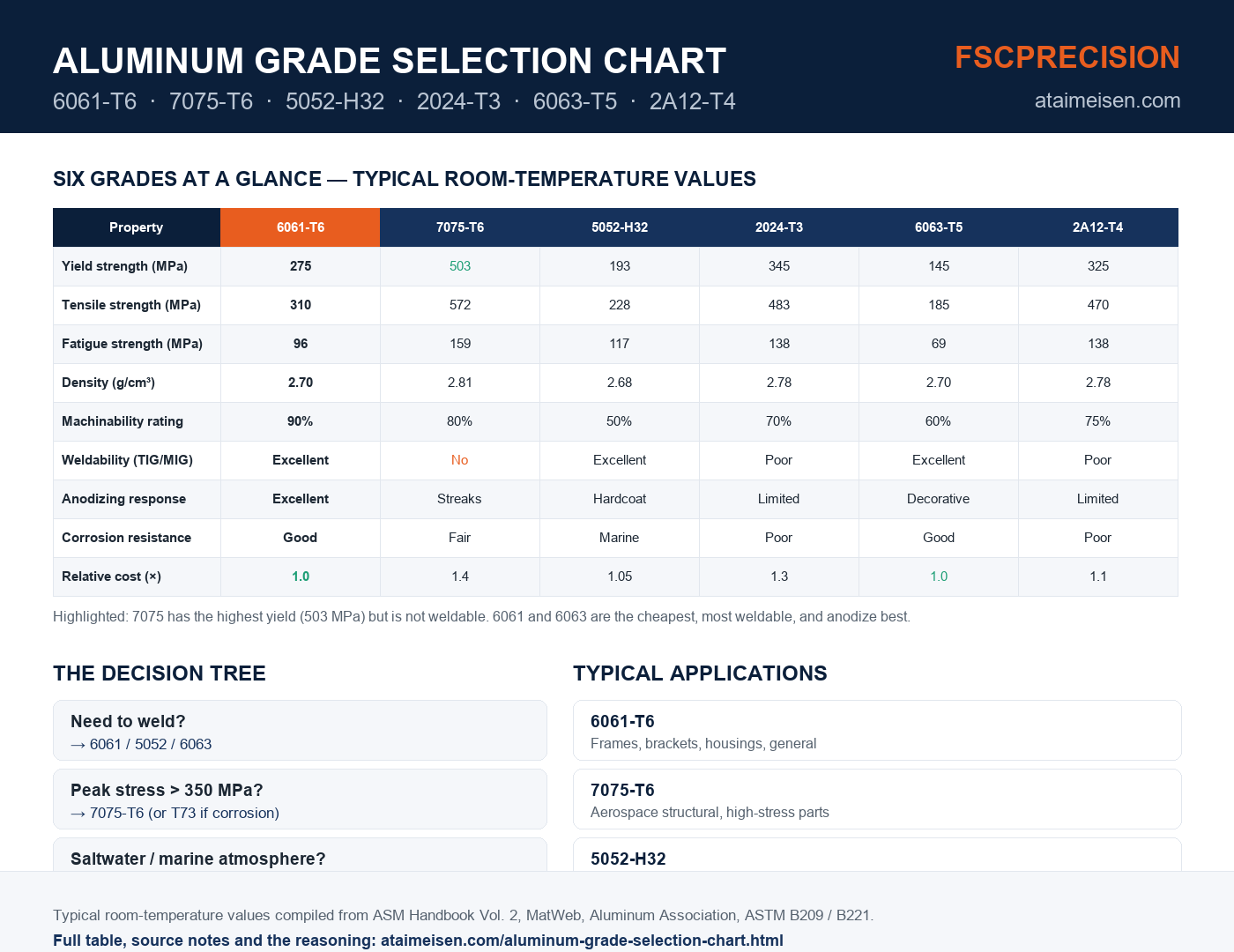
Download PNG for use in slide decks or printed handouts.
